Happy Parents' Day!🥰 Investing from the parents' perspective, with our children's tertiary education in mind
- ckcbiz40
- May 10
- 6 min read

This Mother's Day weekend (and ahead of Father's Day coming up too), I thought of writing something different - Investing from the parents' perspectives 😂
Recently, I chanced upon this interesting article from The Smart Investor here ($85,000 by 2038: 3 Stocks I’m Buying Today to Fully Fund My Child’s Degree), and found it being written from a unique angle to look at our investing goal, i.e. to fund our children's University degree costs.
Before that, wanted to set some context first. My wife and I have always felt that we SHOULD let our 2 kids be independent when they reach tertiary education. After all, my wife and I both supported ourselves through our university education, albeit differently - Wife had a Gahmen scholarship, so university fees and living allowance were no issue for her. As for myself, parents did not have much CPF, so I had to be rely on myself to apply for tuition fee loan from the banks (80% of Uni fees, I still remember it was $17,600 till this date 😆) and to pay the balance 20% Uni fees and my living expenses by teaching tuition during my Uni days (which continued on after I graduated).
Hence, our idea (or at least hope) was for our 2 kids to either get a scholarship or be self-sufficient enough to earn their local Uni fees themselves. Now, notice the word "SHOULD" in bold and underline in the first sentence above?😅 Looking at our 2 kids (or maybe their generation generally), not sure if they can really make it on their own, haiz. So we thought we better be prepared for back up plans, and hence what follows below.


To get the amounts we need for their Uni fees specifically for our 2 kids, I projected as follows: 1) Elder child turns 21 yo (i.e. Uni fees needed in about 6 years' time);
2) Younger child turns 21 yo (i.e. Uni fees needed in about 10 years' time).
Essentially, we will need about $45K (Elder child) + $50K (Younger child) in 6 years' time and 10 years' time respectively, so the magic figure is about $95K. This is a conservative estimate based on the 1st year they enter Uni. Pls note that this is a quick and simplistic manner to get the figure, and everyone's case differs based on your child's profile, gender, age, education route etc.

As far as I know, there are 3 main means to fund a child's Uni fees below:
(1) Using parents' CPF OA (Terms and conditions apply);
(2) Tuition fee loan from the banks (Terms and conditions apply);
(3) Cash + Investment from parents (Father-Mother "scholarship" or i.e. parents blood sweat money 血汗钱 😨).
For the purpose of this post, and the Smart Investor's article mentioned above (i.e. S$85,000 by 2038: 3 Stocks I’m Buying Today to Fully Fund My Child’s Degree) on how/what to invest in to accumulate for our children's Uni fees, I shall focus on (3) above, using cash and/or investments from parents.

Some time ago, we started the following 4 buckets to invest in and/or save up for our children's Uni fees as follows:
(1) Dollar Cost Averaging into REIT ETF: In 2021, managed to convince wife to start to invest in Amova-StraitsTrading Asia ex Japan REIT Index ETF on a monthly basis using POSB Invest-Saver on a dollar cost averaging since 2021 using our joint savings.
This REIT ETF is yielding about ~5% yield per annum, with the top 10 holdings of Asia's largest REITs in first table below, and returns in second table below:

POSB Invest Saver | To buy: Amova-StraitsTrading Asia ex Japan REIT Index ETF | ||
Monthly invest | $200 | Invested amount |
|
Started: Year 0 | Mar-21 |
| Annual Div (~5%) |
1 | Mar-22 | $2,400 | $120 |
2 | Mar-23 | $4,800 | $240 |
3 | Mar-24 | $7,200 | $360 |
4 | Mar-25 | $9,600 | $480 |
5 | Mar-26 | $12,000 | $600 |
6 | Mar-27 | $14,400 | $720 |
7 | Mar-28 | $16,800 | $840 |
8 | Mar-29 | $19,200 | $960 |
9 | Mar-30 | $21,600 | $1,080 |
10 | Mar-31 | $24,000 | $1,200 |
11 | Mar-32 | $26,400 | $1,320 |
Total dividends collected = | $7,920 | ||
Total: Invested + Dividends accumulated = | $34,320 | ||
(2) Endowment fund or DCA into ~6% yielding stocks
We had taken up some endowment funds some years ago, which would yield about $46K (from premium paid ~$31K) when it matures in 2032 thereabouts.
But similarly, one could also DCA monthly into ~6% or more yielding stocks such as companies that I mentioned in my previous posts here: (i) (A Happy shareholder 😍 Full Year 2025 Results for HRnet Group and Comfort Delgro) or here (ii) My football team(stock portfolio)'s Starting 11! Can our reserve players substitute them? 🤔) to achieve similar returns of ~$45,000 (using about $31,000), see below:
Dollar cost average (DCA) | To buy: Stocks yielding ~6% or more | ||
Monthly invest | $250 | Invested |
|
Started: Year 0 | Mar-21 |
| Annual Div (~6%) |
1 | Mar-22 | $3,000 | $180 |
2 | Mar-23 | $6,000 | $360 |
3 | Mar-24 | $9,000 | $540 |
4 | Mar-25 | $12,000 | $720 |
5 | Mar-26 | $15,000 | $900 |
6 | Mar-27 | $18,000 | $1,080 |
7 | Mar-28 | $21,000 | $1,260 |
8 | Mar-29 | $24,000 | $1,440 |
9 | Mar-30 | $27,000 | $1,620 |
10 | Mar-31 | $30,000 | $1,800 |
11 | Mar-32 | $33,000 | $1,980 |
Total dividends collected = | $11,880 | ||
Total: Invested + Dividends accumulated = | $44,880 | ||
(3) Singapore Savings Bonds (SSBs) from the high interest rate period of: 2023 / 2024 (2 tranches of $10K each below):
Again, luckily I managed to convince my wife to deploy the idle cash sitting in our joint savings account earning pathetic 0.5% interest into 2 tranches of SSBs during the high interest period of 2023/2024:
(SSB Apr 23) at 3.15% average over 10 years | Principal: $10,000 | Total: |
Total interest till 2033= | $2,414 | $12,414 |
(SSB Jun 24) at 3.33% average over 10 years | Principal: $10,000 | Total: |
Total interest till 2034= | $2,568 | $12,568 |
(4) Continued monthly savings = $10,000 cash projected to be accumulated by 2031/32
As we all know, cash saving grows at a peanuts rate, so I shall assume no growth here, and maintain the returns at $10,000.
In summary: Projected total returns in about 10/11 years' time = (1) $34,320 + (2) $44,880 + (3) $12,414 + $12,568 + (4) $10,000 = $114,183
Principal amounts invested = (1) $26,400 + (2) $33,000 + (3) $10,000 + $10,000 + (4) $10,000 = $89,400.
In terms of returns: ROI or Simple returns = $114,183 ÷ $89,300 = Approx. +28% (from $25K gains).
CAGR of $114,183 from $89,300 in 11 years = Approx. 2.25% per annum.
As can be seen, with the above diversification of investing/saving into the 4 buckets to attain the $114K, it is projected we will be able to cover the projected $95K Uni fees required for our 2 kids when the time comes. While this is a rather simplistic projection, and may not take into account slightly different maturities or investment end dates or inflation adjusted amounts, it gives a rough sense of the amounts that are achievable. In addition, this is by no means prescriptive of the areas you can invest in or the risk profile(s) we can choose.
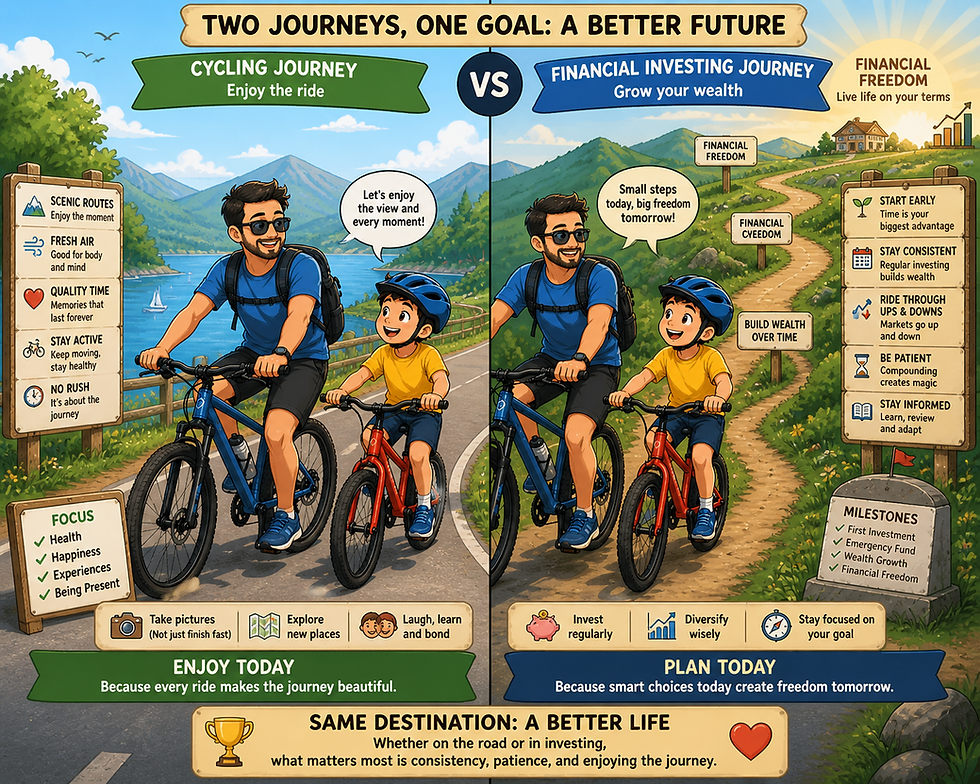
More importantly, I wanted to highlight the need for parents to (i) start investing early, (ii) let our monies compound (iii) DCA monthly to avoid fear, greed or laziness and (iv) plan ahead. 😁
While we all hope our children would be sensible and capable enough not to rely on our blood sweat money (血汗钱) for their tertiary fees, or even if we decide to fund our children's uni fees using the other 2 possible means, e.g. CPF OA or tuition fee loan from banks, it is always good to have this option and back up plan for this $100+K, yes?
Even if not needed, I'm sure we wouldn't mind having this amount to add to our retirement amounts or travelling funds, no? 😉 Let me know your thoughts or if you have other suggestions or alternative plans for your children's uni fees or any other amounts (travel, retirement etc.) you would like to invest for? ☺️
To your money and health,
Mr MoneyandHealth (Mr MH) 🥰
Disclaimer: The author is NOT endorsed by any companies mentioned above to write this post. The author may have been, is still vested, will be investing into several of the companies mentioned above. The above article is purely the author expressing his layman views and babbling nonsense, please forgive if it doesn't make sense. The above article is NOT financial advice, and NOT a recommendation to buy or sell any stocks or REITs. Pls do your own due diligence and/or consult a qualified financial advisor before making any moves or taking any actions. Pls note that past performance or track records is not an indicator or guarantee of future performance or potential.


Comments